

If you are learning how to read a Satta Matka chart, you may come across terms such as Double Digit, Double Number, Jodi, Panel, and Patti. These terms describe different types of numbers and chart information, so understanding their basic meaning can make chart reading much easier.
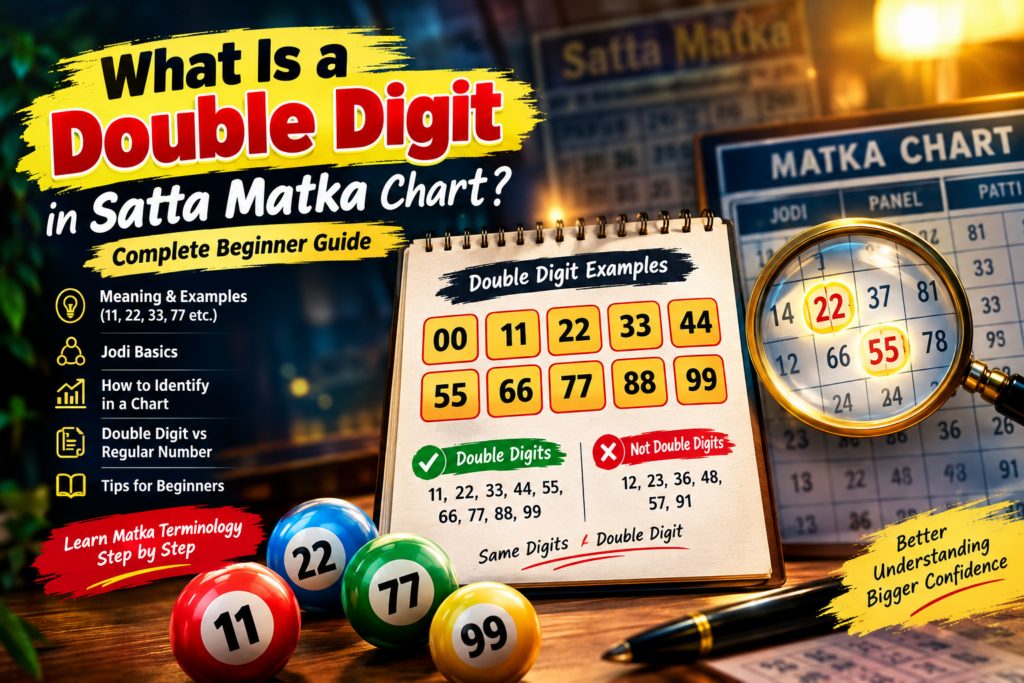
A Double Digit in Satta Matka generally means a two-digit combination in which the same digit appears twice. Examples include 11, 22, 33, 44, 55, 66, 77, 88, and 99.
In simple words, when both digits of a two-digit Jodi are identical, it is commonly called a Double Number. This guide explains the concept with easy examples and shows how beginners can identify double digits in chart records.
What Is a Double Digit in Satta Matka?
A double digit is a two-digit number where the first and second digits are exactly the same.
For example:
00, 11, 22, 33, 44, 55, 66, 77, 88, 99
All of these are double-digit combinations because each number contains the same digit twice.
For comparison:
- 11 → Double
- 22 → Double
- 55 → Double
- 77 → Double
- 25 → Not a Double
- 38 → Not a Double
- 64 → Not a Double
The easiest way to identify one is simply to compare the two digits.
What Is a Double Number?
Double Number is another commonly used term for a two-digit combination containing two identical digits.
For example, if you see 44, the first digit is 4 and the second digit is also 4. Therefore, 44 is a double number.
| Number | Type |
|---|---|
| 11 | Double |
| 24 | Regular |
| 33 | Double |
| 47 | Regular |
| 66 | Double |
| 81 | Regular |
| 99 | Double |
This basic distinction can help new readers understand the number combinations shown on different charts.
How Is a Double Digit Related to Jodi?
Understanding Jodi is helpful when learning about double digits.
A Jodi generally consists of two digits. These digits can be different or identical.
Examples of regular Jodi combinations include:
- 12
- 25
- 38
- 46
- 71
Examples of double Jodi combinations include:
- 11
- 22
- 44
- 77
- 88
Therefore, a double digit can be understood as a specific type of two-digit Jodi where both positions contain the same digit.
How to Find a Double Digit in a Satta Matka Chart
Identifying a double digit does not require any complicated calculation.
Simply follow these steps:
Step 1: Find the two-digit number in the chart.
Step 2: Look at the first digit.
Step 3: Look at the second digit.
Step 4: Compare them.
Step 5: If both digits are identical, the number is a double.
For example, suppose a chart contains:
13, 22, 35, 66, 78
The double numbers are:
22 and 66
The remaining numbers contain two different digits.
Double Digit vs Two-Digit Number
It is important to understand that every double digit is a two-digit number, but every two-digit number is not a double digit.
For example:
Double Numbers
- 00
- 11
- 22
- 33
- 55
- 77
Other Two-Digit Numbers
- 12
- 23
- 45
- 58
- 69
- 91
The difference is based entirely on whether the two digits match.
Complete Double Number List
There are ten basic double combinations when using digits from 0 to 9:
00, 11, 22, 33, 44, 55, 66, 77, 88, 99
You can identify each one by looking for the repeated digit.
For example:
- 00 contains two zeros.
- 33 contains two threes.
- 55 contains two fives.
- 88 contains two eights.
This repeated structure is what defines a double number.
Why Do Double Digits Appear in Charts?
Charts can contain different types of recorded number information, including single digits, Jodi combinations, panels, and other market-related entries.
A double number may therefore appear as part of a historical chart record.
Readers may look at these entries to:
- Understand basic chart terminology
- Learn how Jodi combinations are displayed
- Review previous chart records
- Become familiar with different number formats
- Understand the structure of a particular market chart
However, a previous appearance of a double number does not mean that the same number will necessarily appear again.
Double Digit vs Single Digit
Beginners sometimes confuse a single digit with a double digit.
The difference is straightforward.
| Number Format | Example |
|---|---|
| Single Digit | 4 |
| Single Digit | 8 |
| Double Digit | 11 |
| Double Digit | 55 |
| Two-Digit Number | 27 |
| Double Number | 77 |
A single digit has one numerical position, while a double digit has two positions containing the same digit.
Double Digit vs Regular Jodi
A regular Jodi can contain either matching or different digits depending on the terminology being used by a particular chart.
For basic understanding:
Different digits:
12, 24, 36, 48, 59
Matching digits:
11, 22, 33, 44, 55
The second group represents the simple double-number pattern.
Because terminology can vary between websites and markets, readers should always check how a particular chart defines and displays its numbers.
Can Double Digits Predict Future Results?
A historical double digit should not be considered a guaranteed prediction.
For example, if 44 appeared in a previous chart, that only tells you that 44 was recorded in that particular historical record. It does not establish that 44 will appear again.
Historical charts are useful for understanding and reviewing past information, but past records do not guarantee future results.
This distinction is especially important for beginners who are learning chart terminology.
How Beginners Can Learn Double Digits Easily
You do not need to memorize complicated rules to understand double numbers.
Start with these simple points:
1. Remember the Basic Rule
A double number has the same digit twice.
2. Compare Both Positions
Look at the first and second digits separately.
3. Learn Jodi Basics
Understanding two-digit combinations makes chart terminology easier to follow.
4. Understand Historical Records
Previous chart entries represent recorded information, not guaranteed future outcomes.
5. Learn One Term at a Time
Start with single digits and double digits before moving on to other chart terminology such as Panel, Patti, and Jodi.
Common Examples of Double Digits
Here are the most common examples:
00, 11, 22, 33, 44, 55, 66, 77, 88, 99
Some quick examples:
- 11 → Double
- 22 → Double
- 34 → Not Double
- 55 → Double
- 67 → Not Double
- 88 → Double
- 92 → Not Double
The rule remains the same in every example: both digits must match.
Why Should Beginners Learn Matka Number Terminology?
When you first visit a Satta Matka chart, you may see several unfamiliar terms together. Understanding their basic meanings can make the information easier to follow.
Learning terminology can help you understand:
- Single digits
- Double digits
- Jodi numbers
- Panel and Patti
- Historical chart entries
- Market-related number formats
A strong understanding of basic terms also makes it easier to read other educational articles about Satta Matka charts.
Key Things to Remember About Double Digits
Here are the main points in simple form:
- A double digit contains the same digit twice.
- Examples include 11, 22, 44, 77, and 99.
- 25 and 48 are two-digit numbers but are not doubles.
- Double numbers are commonly associated with two-digit Jodi combinations.
- Charts may display double numbers as part of historical records.
- Different websites may organize chart information differently.
- Previous results should not be treated as guaranteed future predictions.
Conclusion
Understanding what a Double Digit means in a Satta Matka chart is quite simple. A double digit is a two-digit combination where both digits are identical, such as 11, 33, 55, or 88.
Once you understand this basic pattern, it becomes easier to recognize double numbers and understand their relationship with Jodi and other chart terminology.
For beginners, the best approach is to focus on the structure of the number rather than trying to attach predictions to historical entries. Previous chart information can be useful for reference and learning, but it should not be considered a guarantee of future results.
Frequently Asked Questions
What is a Double Digit in Satta Matka?
A Double Digit is a two-digit combination where both digits are the same. Examples include 11, 22, 66, and 99.
What are examples of Double Numbers?
The basic double numbers are 00, 11, 22, 33, 44, 55, 66, 77, 88, and 99.
Is 25 a Double Number?
No. The digits 2 and 5 are different, so 25 is not a double number.
Is 77 a Double Digit?
Yes. Both positions contain the digit 7, making 77 a double number.
How can I identify a Double Digit in a chart?
Look at the two digits and compare them. If the first and second digits are identical, it is a double digit.
What is the difference between a Single Digit and Double Digit?
A single digit contains one numerical position, such as 5. A double digit contains two identical digits, such as 55.
Does a previous Double Digit guarantee a future result?
No. A previous chart entry only represents historical information. It should not be treated as a guaranteed prediction of a future result.

Other Articles
Single Panna vs Double Panna vs Triple Panna: Complete Guide
No Comment! Be the first one.